Sewer Line Replacement Cost (2026): Per Foot, Trenchless and Repair
Sewer line replacement cost for most homes runs about $3,500 to $12,000, or roughly $50 to $250 per foot depending on the method. A spot repair of one broken section is cheaper, usually $1,000 to $4,000. The final number depends on how long the line is, how deep it sits, what's on top of it, and whether the crew can go trenchless instead of digging a full trench. A $150 to $500 camera inspection is the first step, because it tells you which of those jobs you actually need.
Typical full replacement
$3,500 to $12,000
- Urgency
- Fix this week if backing up
- DIY difficulty
- Pro only
- Time to fix
- 1 to 3 days
- Prices
- US typical range
Last reviewed October 2026
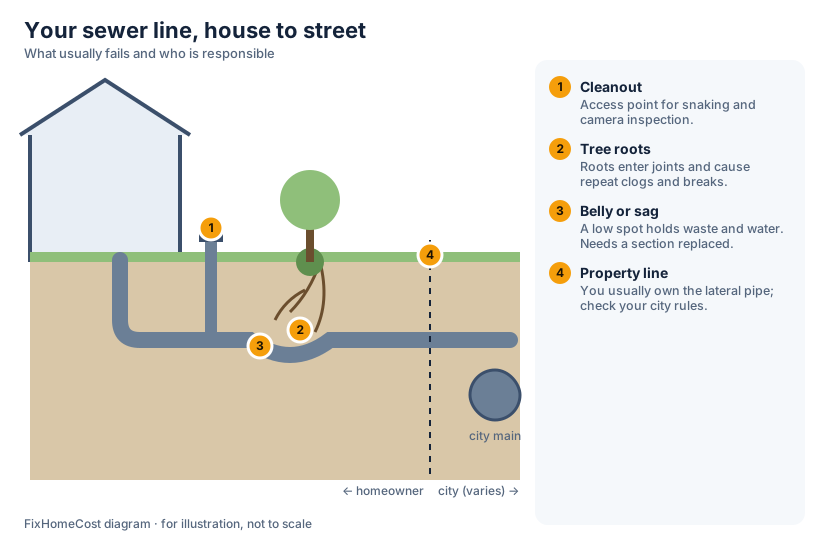
Sewer line replacement cost breakdown
Your sewer lateral carries everything from the house to the city main or septic tank. Its length drives most of the sewer line replacement cost. Most run 40 to 100 feet and sit 2 to 6 feet deep, though some go deeper than 10 feet. Here's what the common jobs cost.
| Job | Typical cost |
|---|---|
| Sewer camera inspection | $150–$500 |
| Locating the line (depth and route) | $100–$300 |
| Snake the main line (temporary relief) | $150–$500 |
| Hydro jet the main sewer line | $500–$1,500 |
| Spot repair of one broken or cracked section | $1,000–$4,000 |
| Typical full lateral replacement | $3,500–$12,000 |
| Long, deep or under-driveway replacement | $12,000–$20,000 |
| New outdoor cleanout | $500–$2,500 |
| City permit and tap connection | $100–$1,500 |
| Driveway, sidewalk or landscape restoration | $500–$5,000 |
Ranges are typical US prices compiled by FixHomeCost from published cost guides. Work that runs under a street, very deep lines and big-city labor rates can push a job past $20,000.
Cost per foot: dig, pipe bursting or lining
Contractors usually quote sewer work per linear foot, then add fixed costs like the permit, pits and restoration. The method changes both the per-foot price and how much of your yard gets torn up.
| Method | Typical cost |
|---|---|
| Traditional dig and replace | $50–$200/ft |
| Trenchless pipe bursting | $60–$200/ft |
| Trenchless pipe lining (CIPP) | $80–$250/ft |
Traditional dig and replace
An excavator opens a trench along the whole run and the old pipe is swapped for new PVC. The per-foot price is often the lowest, and it works for any pipe condition, including a fully collapsed line. The catch is restoration. Lawn, plantings, walkways and driveway sections over the trench all need rebuilding, which can add $3,000 to $8,000.
Pipe bursting
The crew digs two small pits, one at each end. A cone-shaped head is pulled through the old pipe, breaking it apart while dragging a new HDPE pipe in behind it. It's a good choice when the line has failed throughout but is still passable, and it can upsize the pipe slightly.
CIPP lining
A resin-soaked felt liner is pulled or inverted into the cleaned pipe, then cured to form a new pipe inside the old one. It often needs no digging at all. It needs a round, mostly intact host pipe, so it's best for cracks, root intrusion and leaky joints, not collapses or bad sags.
Trenchless sewer line replacement is not always cheaper on the invoice. Where it saves money is everything above the pipe. If your line runs under a driveway, a mature tree or a finished patio, trenchless usually wins on the total. Under open lawn, digging is often the better value.
Worked example: a 60-foot sewer line
Say a 1960s house has a 60-foot clay lateral full of roots, with 15 feet of it under a concrete driveway. Here's how two quotes might compare.
Pipe bursting: 60 ft × $120 = $7,200. Add a camera inspection ($300), permit ($300), a new two-way cleanout ($800) and lawn repair over the two pits ($600). Total: $9,200.
Dig and replace: 60 ft × $80 = $4,800. Add the same inspection, permit and cleanout ($1,400), lawn restoration along the trench ($1,200) and cutting and repouring the driveway section ($2,800). Total: $10,200.
The trench quote looked cheaper per foot, but the driveway flipped it. Without the driveway, digging would have come in around $7,400. Always compare the full, restored price.
Sewer line repair or full replacement?
Plenty of sewer line repair calls end with a spot fix, not a whole new line. The camera video decides it. Ask to see the footage counter at each defect.
A spot repair can make sense when
- One cracked sewer pipe joint or a single broken section is the only problem
- The rest of the line is PVC or ABS in good shape
- Roots are getting in at one joint that can be dug up or lined
- The damaged spot is shallow and easy to reach
Full replacement usually wins when
- The camera shows cracks, offsets or roots at several joints
- The pipe is Orangeburg, or clay or cast iron past 50 years
- There's a long sag (belly) holding standing water
- You've paid for several snaking or jetting visits in a few years
For a damaged sewer line repair at one spot, expect $1,000 to $4,000, more if it's deep or under concrete. Lining just a short section, often called a sectional or point repair liner, falls in a similar range. A sewer line leak repair at a single joint is the cheapest version of this job.
Before you spend on any of it, make sure the line is really the problem. For the warning signs and how to diagnose them, see our sewer line repair guide. A simple main drain clog looks a lot like a broken line, and costs a few hundred dollars to clear.
Pipe materials: what you have and what goes in
Clay was common before the 1970s. It lasts a long time, but its many short joints let roots in. Cast iron rusts and scales from the inside and cracks along the bottom. Orangeburg, a tar-and-fiber pipe used from about 1945 to 1972, deforms and collapses. If you have it, read our Orangeburg pipe replacement cost guide, since lining is rarely an option for it.
New lines are usually PVC for dig and replace, HDPE for pipe bursting, or a cured resin liner. ABS is used in some regions and costs about the same as PVC. The pipe itself is a small part of the bill. Labor, digging and restoration are where the money goes.
Extra costs that show up on sewer quotes
Camera inspection and locating
A camera inspection runs $150 to $500. Some plumbers credit it toward the repair. Locating adds $100 to $300 and marks the line's route and depth on the ground.
Cleanout installation
Many older homes have no outdoor cleanout. Adding one runs $500 to $2,500, and many cities require it with a new lateral. It makes every future cleaning cheaper.
City tap and permits
Permits and the connection at the city main usually total $100 to $1,500. If the main is under the street, a street cut, traffic control and paving repair can add several thousand dollars.
Restoration
Lawn and plantings cost the least to put back. Concrete driveways, sidewalks and patios cost the most. Ask whether the quote includes rough grading only or finished restoration.
Backwater valve
If you've had sewage come up a floor drain, ask about a backwater valve while the line is open. It stops city sewage from flowing back into the house.
Depth and soil
Trenches deeper than about 5 feet need shoring or a trench box. Rock, high groundwater and tight access between houses all raise the price.
Cost to fix a sewer backup
A sewer backup has two bills: clearing the line and cleaning up the house. Clearing usually means snaking ($150 to $500) or hydro jetting ($500 to $1,500), plus a camera inspection to find out why it happened. Our hydro jetting cost guide explains when jetting is worth it.
Cleanup is the bigger number. Sewage is contaminated water, and soaked drywall, carpet and insulation have to come out. Professional sewage cleanup often runs $1,000 to $5,000, and more in a finished basement. If water is coming up through the lowest drain, see floor drain backup for what to do right now.
Who pays: homeowner, city or insurance?
In most US cities, the homeowner owns the sewer lateral from the house to the city main, including the part under the sidewalk and sometimes under the street. Some cities take over at the property line or at the curb cleanout. Call your public works or sewer department and ask exactly where your responsibility ends before you sign a contract. A few cities also offer lateral replacement rebates or low-interest loans.
Standard homeowners insurance usually excludes sewer lines that fail from age, wear, roots or settling. Two add-ons can help:
- Service line coverage is an endorsement that pays to repair or replace buried utility lines, often up to $10,000 or more, for a small yearly cost.
- Water backup coverage helps pay for cleanup inside the house after a sewer or drain backup. It often doesn't cover fixing the pipe.
Check your policy for both before work starts. Utility warranty plans for the lateral exist too, but many cap payouts well below a typical sewer line replacement cost.
How to get a sewer line replaced without overpaying
- 1
Cut water use and get the line cleared if it's backing up. Snaking or jetting buys time and lets the camera see the pipe.
- 2
Book a camera inspection. Ask for the video, the pipe material, and the footage and depth of every defect.
- 3
Call your city to find where your responsibility ends, which permits apply, and whether a cleanout is required.
- 4
Check your homeowners policy for service line and water backup coverage, and call the insurer before work begins.
- 5
Get at least three written quotes. Ask each one for spot repair, lining, pipe bursting and dig-and-replace options where they apply.
- 6
Compare the full price, including permit, cleanout, tap and restoration. Run any number through our quote check tool.
- 7
Confirm the warranty in writing. Ten years or more on a new line or liner is common from established contractors.
- 8
Ask for a final camera run after the work, and keep a copy of the video for your records and for any future sale.
Ways to save
- Ask if the camera fee gets credited to the repair
- Line or burst under concrete, dig under open lawn
- Do your own final landscaping and seeding
- Ask about city rebate or cost-share programs
- Add service line coverage before anything fails
Call a pro right away when
- Sewage is coming up a floor drain or tub
- Several drains are slow or gurgling at once
- There's a sinkhole or soggy strip over the line
- A camera shows a collapse or heavy roots
- You smell sewer gas in the yard or house
This is not a DIY job. Trenches over 5 feet deep can collapse, and most cities require a licensed contractor and an inspection. If you want to compare labor rates first, see plumber cost per hour.
Common questions
How much does it cost to replace a sewer line?
Most full sewer line replacements cost $3,500 to $12,000. Long, deep lines or work under a driveway or street can reach $12,000 to $20,000 or more. Per foot, expect about $50 to $250 depending on the method.
How much does main sewer line repair cost?
Repairing one broken or cracked section usually costs $1,000 to $4,000. If the camera finds problems along much of the line, replacing it is often the better value over the long run.
Is trenchless sewer replacement cheaper?
Per foot it's similar or a little higher, at about $60 to $250. It often costs less in total when the line runs under a driveway, patio or trees, because there's far less to restore afterward.
What does it cost to fix a sewer backup?
Clearing the line costs $150 to $1,500, depending on snaking or jetting. Cleaning up sewage inside often adds $1,000 to $5,000. If the backup was caused by a broken pipe, the repair comes on top of that.
Does homeowners insurance cover sewer line replacement?
Usually not when the pipe failed from age, roots or wear. A service line endorsement can cover the pipe, and water backup coverage can help with cleanup inside the house. Check your policy before work starts.
Who is responsible for the sewer line, me or the city?
In most places, the homeowner owns the lateral from the house to the city main. Some cities take over at the property line or curb. Call your public works department to confirm.
How long does it take to replace a sewer line?
Most jobs take 1 to 3 days. Trenchless work is often done in a day. Permits, inspections and concrete restoration can stretch the whole project over a week or two.
Related guides
This is general information, not a professional inspection. See how we research costs.