Orangeburg Pipe Replacement Cost (2026): What to Expect
Orangeburg pipe replacement costs about $3,000 to $15,000 for most homes, and the typical job lands around $5,000 to $9,000. Orangeburg is a fiber-and-tar sewer pipe used from the 1940s to the early 1970s. It's past its life span now. It flattens, blisters and lets roots in, until it collapses. The price depends mostly on how long the line is, how deep it runs, and whether it can be replaced without digging a full trench. A $150 to $500 camera inspection tells you which.
Typical total cost
$3,000 to $15,000
- Urgency
- Plan soon; urgent if backing up
- DIY difficulty
- Pro only
- Time to fix
- 1 to 3 days
- Prices
- US typical range
Last reviewed October 2026
What Orangeburg pipe is, and why it fails
Orangeburg pipe was made from layers of wood pulp fiber pressed together and soaked in coal tar pitch. It was named after the town in New York where it was made. After World War II, metal was scarce and builders needed something cheap and light for sewer lines, so it was used widely from roughly 1945 until the early 1970s. Production ended in 1972.
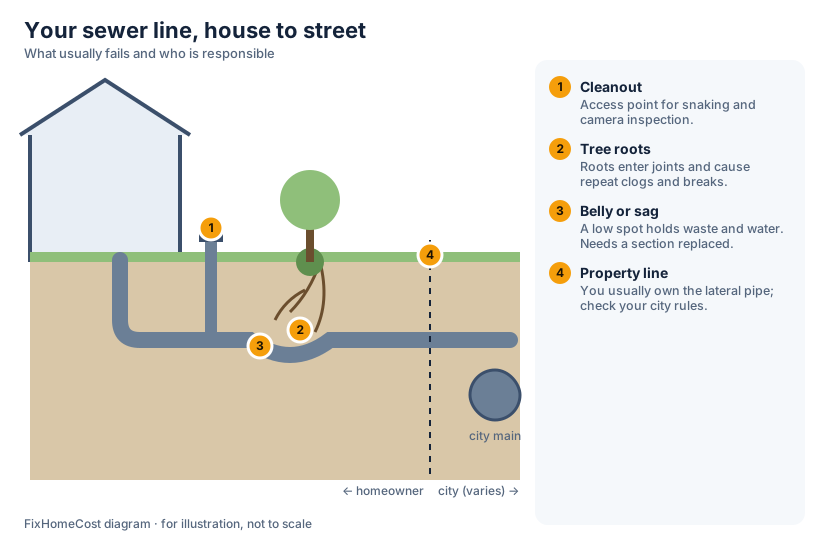
It was never meant to last forever. Most estimates put its useful life at around 50 years, and every Orangeburg line still in the ground is past that. Over time the fiber softens and the pipe deforms under the weight of the soil. It goes from round to oval to nearly flat. Blisters form on the inside wall and catch waste. Tree roots find their way through the soft walls. Eventually sections collapse.
It's usually found in the sewer lateral, the pipe that runs from your house to the city sewer main or septic tank. Houses built between about 1945 and 1972 in many US suburbs are the most likely to have it.
Signs your Orangeburg sewer pipe is failing
- Slow drains throughout the house, not just one sink
- Gurgling toilets, or water rising in the tub when the washing machine drains
- Sewage backing up into the lowest drain, often a basement floor drain
- A sewer smell inside or in the yard (see sewer smell in house)
- A soggy strip or sunken line in the lawn between the house and the street
- Repeated clogs that come back weeks after being snaked
- Unusually green, lush grass along the sewer line's path
Orangeburg pipe replacement cost breakdown
The two biggest cost drivers are the length of the line and the method. A typical sewer lateral runs 40 to 100 feet. Depth, driveways, sidewalks, trees and city permit rules all add to the price.
| Job | Typical cost |
|---|---|
| Sewer camera inspection | $150–$500 |
| Snake or hydro-jet to clear a clog (temporary) | $200–$600 |
| Spot repair of one collapsed section | $1,000–$4,000 |
| Replacement, per linear foot | $60–$125 |
| Typical full lateral replacement | $5,000–$9,000 |
| Full replacement, total range | $3,000–$15,000 |
| Restoring driveway, sidewalk or landscaping | $500–$5,000 |
| City permit and tap connection | $100–$1,500 |
Ranges are typical US prices compiled by FixHomeCost from published cost guides. Jobs that run under a driveway or street, or that go very deep, can go above $15,000. Compare with our general sewer line repair guide.
Replacement methods and how they affect the price
Traditional dig and replace
A trench is dug along the whole line and the old pipe is swapped for PVC. It's the most predictable method, and often cheaper per foot, but it tears up the lawn, paths and driveway, so restoration costs get added on.
Pipe bursting (trenchless)
A bursting head is pulled through the old line from one small pit to another. It breaks up the Orangeburg and pulls new pipe in behind it. It needs much less digging, which makes it a good fit for Orangeburg when the line is still passable.
Pipe lining (usually not an option)
Lining coats the inside of an existing pipe. It needs a sound, round host pipe, which deformed Orangeburg usually isn't. Be cautious if a contractor offers to line a flattened Orangeburg line.
Spot repair
One collapsed section is dug out and replaced. It can buy time, but the rest of the line is the same age and will fail too. Most plumbers recommend replacing the whole run.
What to do if you think you have Orangeburg pipe
- 1
Check the year your house was built. Between about 1945 and 1972 is the risk window. Older homes may also have had their lateral replaced with Orangeburg during that era.
- 2
Book a sewer camera inspection. Ask for the video and the footage counter, so you know the pipe material, its condition and the exact length.
- 3
If a clog is causing backups right now, have it cleared so the house is usable. Know that snaking or jetting is a temporary fix on Orangeburg, and aggressive jetting can damage soft pipe further.
- 4
Get at least three written quotes. Ask each contractor which method they'd use, how many feet they're replacing, and whether the permit, the connection at the main and the surface restoration are included.
- 5
Call your city or water utility. Some offer lateral replacement programs, cost sharing or approved contractor lists. Many also require a permit and an inspection.
- 6
Check your homeowners policy for "service line" coverage. Standard policies usually exclude wear and age, but an optional service line endorsement may cover part of the cost.
Questions to ask contractors
- What pipe material and diameter will you install?
- Is the price per foot, or fixed for the whole run?
- Who restores the lawn, driveway and sidewalk?
- Do you pull the permit and arrange the inspection?
- What warranty comes with the work?
Call a pro right away when
- Sewage is backing up into the house
- The yard has a sinkhole or a constantly wet spot
- Several drains are slow at the same time
- A camera shows a collapse or heavy root mass
Common questions
How much does Orangeburg pipe replacement cost?
Most homeowners pay $3,000 to $15,000, and a typical lateral costs $5,000 to $9,000. That's roughly $60 to $125 per foot, plus restoration and permits.
How long does Orangeburg pipe last?
About 50 years. Because it was installed from the 1940s to the early 1970s, almost all remaining Orangeburg pipe is at or past the end of its life.
How do I know if I have Orangeburg pipe?
A sewer camera inspection is the only reliable way. On camera it looks black and fibrous, and it's often oval or blistered. Homes built between about 1945 and 1972 are the most likely to have it.
Can Orangeburg pipe be lined instead of replaced?
Rarely. Lining needs a sound, round pipe to bond to, and Orangeburg is usually deformed. Pipe bursting or dig-and-replace is the normal fix.
Does homeowners insurance cover Orangeburg pipe replacement?
Usually not, because failure from age and wear is excluded. A service line endorsement, if you have one, may pay for part of it. Some cities also offer lateral assistance programs.
Should I buy a house with Orangeburg pipe?
It doesn't have to stop the purchase. Get a sewer camera inspection and a replacement quote, then negotiate the price or ask the seller to replace the line before closing.
Related guides
This is general information, not a professional inspection. See how we research costs.