Foundation Crack Repair Cost (2026): Prices by Crack Type
Foundation crack repair cost is usually $250 to $800 per crack for professional injection, and most homeowners with one or two leaking cracks pay $500 to $1,500 in total. Structural cracks are a different job: a horizontal crack in a bowing wall typically costs $4,000 to $12,000 per wall to stabilize, and settling that needs piers runs $1,000 to $3,000 per pier. The shape, width and direction of the crack tell you which bill you're facing, so start there.
Typical cost per crack
$250 to $800
- Urgency
- Fix leaks this season
- DIY difficulty
- Moderate (non-structural)
- Time to fix
- 2 hours to 3 days
- Prices
- US typical range
Last reviewed October 2026
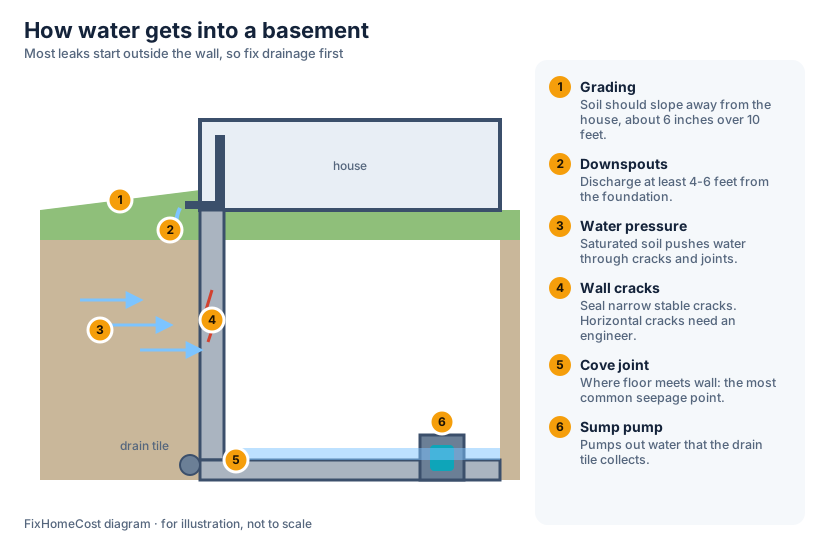
What you're really paying for
Almost every concrete foundation cracks, because concrete shrinks as it cures and soil settles and freezes around it. So the price depends on two questions. Is the crack letting water in? And is it still moving? A dry, stable hairline crack might cost nothing. A leaking vertical crack is a few hundred dollars. A wall pushing inward is a structural repair in the thousands.
For warning signs and a DIY injection walkthrough, see the foundation crack repair guide. This page covers what each repair costs.
Foundation crack types, what they mean and what they cost
Hairline shrinkage cracks
Thinner than a credit card, usually showing in the first year or two. Normal. Leave them alone unless they leak. If they do, injection runs $250 to $500.
Vertical cracks
Straight up and down, or close to it, often wider at the top. Usually shrinkage or minor settling. The most common leaking crack. Injection costs $250 to $800 per crack.
Diagonal cracks
Run at roughly 30 to 75 degrees, often from a window corner. Usually differential settling. If under 1/8 inch and stable, injection runs $300 to $800. If one side is offset, get an engineer.
Stair-step cracks
Follow the mortar joints in a block or brick wall. Small and stable ones are sealed or repointed for $400 to $1,500. Wide or displaced ones mean settling or soil pressure, often $1,000 to $5,000+.
Horizontal cracks
Run along the wall, often 2 to 4 feet below grade. Soil pressure is pushing the wall in. Always structural. Stabilizing usually costs $4,000 to $12,000 per wall.
Slab floor cracks
Thin cracks in a basement floor are shrinkage and rarely matter. Sealing one costs $150 to $500. Heaving or sinking slabs are another story, see below.
How much does foundation crack repair cost?
These prices include labor and materials. They line up with the ranges in our foundation repair cost calculator, which can total several cracks, piers and wall repairs for your house.
| Job | Typical cost |
|---|---|
| DIY polyurethane injection kit | $60–$150 |
| Seal a basement floor (slab) crack | $150–$500 |
| Polyurethane injection, per crack | $250–$800 |
| Epoxy injection (dry structural crack), per crack | $300–$800 |
| Several cracks, whole project | $500–$3,000 |
| Exterior dig-down crack repair, per crack | $1,000–$3,000 |
| Structural engineer inspection | $300–$800 |
| Carbon fiber straps, per wall | $4,000–$8,000 |
| Wall anchors, per wall | $5,000–$10,000 |
| Steel I-beam braces, per wall | $5,000–$12,000 |
| Foundation pier, each | $1,000–$3,000 |
| Exterior waterproofing, per linear foot | $100–$200 |
Ranges are typical US prices compiled by FixHomeCost from published cost guides. Long cracks, finished walls that need to be opened, and high-cost metro areas push prices to the top of each range.
Epoxy vs polyurethane injection: cost per crack
Most basement crack repairs in poured walls are done by low-pressure injection from inside. The crew glues ports along the crack, seals the face, then pumps resin in from the bottom up through the full wall thickness. Expect 2 to 4 hours per crack.
Polyurethane foams and stays flexible. It works in a damp or actively leaking crack and moves a little with the wall, so it's the standard choice when the goal is to stop water. Typical cost is $250 to $800 per crack, up to about $1,000 for a long crack that runs floor to ceiling in a tall wall.
Epoxy cures hard and bonds the two sides of the crack back together. It needs a dry crack and a stable wall, and it's used when an engineer wants strength restored, not just a watertight seal. It runs about $300 to $800 per crack.
Neither one fixes a wall that is still moving. Injecting a horizontal crack without bracing the wall just means the wall cracks again next to your repair.
DIY crack injection kits
A polyurethane kit costs $60 to $150 and handles roughly 10 feet of crack. If you're handy and the crack is a simple vertical one in a poured wall, it's a reasonable weekend job. Surface caulk and hydraulic cement often fail because water pushes in behind them. Kits don't work on block walls, since the hollow cores swallow the resin.
Foundation crack leak and water leak in a basement wall
A foundation crack leak shows up as a damp stripe, white crust or a trickle after rain. Injection from inside stops most of them. First check outside: downspouts dumping next to the wall and soil sloping toward the house send water straight into the crack. Fixing grading and downspouts can cost less than the crack repair and protects the whole wall.
When inside access isn't possible, contractors dig down outside, seal the crack and add a membrane, for $1,000 to $3,000 per crack. If water is coming in along several walls or where the floor meets the wall, you have a groundwater problem, not a crack problem. Compare floor-wall seepage fixes and basement waterproofing cost before sealing cracks one at a time. The basement leak finder can help narrow down the cause.
Structural repairs: straps, anchors and piers
Carbon fiber straps are epoxied to the inside of a bowing wall, usually every 4 to 6 feet. They work for walls that have moved less than about 2 inches. Each strap runs roughly $500 to $1,000 installed, and most walls land at $4,000 to $8,000.
Wall anchors run a steel rod through the wall to a plate buried in the yard. Expect $500 to $1,000 per anchor and $5,000 to $10,000 per wall. You need open yard space on that side.
Steel I-beam braces bolt to the floor and the floor framing. They cost $5,000 to $12,000 per wall and work when the yard side is blocked.
Piers fix foundation settling. Steel push or helical piers are driven to stable soil to support or lift the house. Each pier costs $1,000 to $3,000, and a settling corner typically needs 4 to 6. That's why foundation settling repair cost usually starts around $4,000 and can pass $15,000 for a whole wall. See the full foundation repair cost guide for pier jobs.
Basement floor heaving repair cost
A floor that rises in the middle, with cracks that are higher on one side, is usually expansive clay swelling under the slab, or sometimes frost or a plumbing leak. Cutting out and repouring a heaved section runs about $1,000 to $5,000. Severe heaving can pass $10,000, because the soil under the slab has to be dealt with. A floor that has sunk instead can often be lifted with mudjacking ($3 to $6 per square foot) or polyurethane foam ($5 to $10 per square foot). Rule out a slab leak first if the heave appeared suddenly.
When to worry: width thresholds
Measure the widest point with a crack gauge. Common rules of thumb:
- Under 1/16 inch: normal shrinkage. Seal only if it leaks.
- 1/16 to 1/8 inch: usually not structural. Inject if it leaks, and mark the ends to watch for growth.
- 1/8 to 1/4 inch: watch closely. Get an engineer if it's diagonal, stair-step, or wider at one end.
- Over 1/4 inch: get a structural engineer before any repair.
- Any horizontal crack, any offset, or any bow: structural, whatever the width.
Other red flags: sticking doors and windows, sloping floors, gaps at trim, and a crack that grows past your pencil marks. An independent engineer's inspection costs $300 to $800. The engineer isn't selling you the repair, and the report tells contractors exactly how many straps or piers to price.
Worked example: two common jobs
Leaking vertical cracks. A poured basement wall has two vertical cracks, each about 1/16 inch wide and 7 feet long, both damp after heavy rain. A contractor quotes polyurethane injection at $550 per crack. Two cracks at $550 is $1,100. Add two 10-foot downspout extensions for $40. Total: $1,140. No engineer needed, since the cracks are thin and vertical.
Horizontal crack in a block wall. A 30-foot block wall has a horizontal crack and bows in about 1 inch. The engineer charges $500 and calls for carbon fiber straps every 5 feet, which is 6 straps. At $800 per strap that's 6 × $800 = $4,800. The crack is then sealed for $400. Total: $500 + $4,800 + $400 = $5,700.
Warranties and ways to save
Most injection companies warranty the repaired crack against leaks, often for life and sometimes transferable to a buyer. It covers that crack only. Wall bracing and pier systems usually carry long transferable warranties as well. Get it in writing, and keep it with the engineer's report. Buyers ask for both.
- Fix gutters, downspouts and grading first. It's the cheapest way to stop many leaking cracks.
- Have all the cracks done in one visit to pay setup once.
- Hire the engineer yourself, then get 2 to 3 quotes based on the report. Run any quote through the quote checker.
- Don't let a company sell you full waterproofing when one crack is the only leak.
Homeowners insurance usually doesn't pay for cracks from settling, shrinkage or soil pressure. It may cover foundation damage from a sudden covered event, such as a burst pipe.
How to handle a foundation crack, step by step
- 1
Measure the crack at its widest point and note its direction: vertical, diagonal, stair-step or horizontal.
- 2
Mark both ends with a pencil and the date. Check again in 4 to 6 weeks to see if it's growing.
- 3
Check the outside. Extend downspouts 6 to 10 feet and make sure soil slopes away from the wall.
- 4
If the crack is horizontal, offset, wider than 1/4 inch or growing, hire an independent structural engineer.
- 5
For a thin leaking crack in a poured wall, choose polyurethane injection, by a pro or with a DIY kit.
- 6
Get 2 to 3 written quotes that list the method, the number of cracks, straps or piers, and the warranty.
Tools and materials
- Crack gauge or feeler gauges
- Pencil and tape measure
- 4-foot level to check for bowing
- Polyurethane injection kit (DIY only)
- Wire brush and shop vacuum
Approximate DIY cost: $60 to $150
Call a pro when
- The crack is horizontal or stair-stepped and wide
- The wall bows, leans or one side is offset
- The crack is wider than 1/4 inch or growing
- Doors stick or floors slope
- The wall is concrete block
- Water still comes in after a DIY injection
Common questions
How much does foundation crack repair cost?
Most non-structural cracks cost $250 to $800 each to inject. A typical job with one or two cracks runs $500 to $1,500. Structural cracks that need straps, anchors or piers cost $4,000 to $12,000 or more.
How much does basement crack repair cost if it's leaking?
Polyurethane injection for a leaking basement crack typically costs $250 to $800, up to about $1,000 for a long crack. If it has to be repaired from outside by digging down, expect $1,000 to $3,000.
How do I repair a water leak in a basement wall?
Fix gutters and grading first, then inject the crack with polyurethane from inside. If water comes in along the floor or several walls, you likely need interior drain tile and a sump pump, which usually costs $3,000 to $10,000.
What foundation cracks should I worry about?
Horizontal cracks, wide stair-step cracks, cracks wider than 1/4 inch, cracks where one side sticks out past the other, and any crack that keeps growing. Have an engineer look at these before you pay for a repair.
What does foundation settling repair cost?
Piers cost about $1,000 to $3,000 each, and a settling corner usually needs 4 to 6, so most settling repairs run $4,000 to $15,000. An engineer's report sets the pier count.
Does homeowners insurance cover foundation crack repairs?
Usually not. Settling, shrinkage and soil pressure are treated as wear or maintenance. Damage from a sudden covered event, like a burst pipe, may be covered.
Related guides
This is general information, not a professional inspection. See how we research costs.