AC Breaker Keeps Tripping? 8 Causes, What to Check & Repair Costs
An AC breaker that keeps tripping is protecting you from something: the air conditioner is drawing more current than the circuit allows. The usual causes are a dirty filter or outdoor coil, a failing capacitor, a struggling motor, or loose wiring. Reset it once. If it trips again, leave it off and call a technician. Most fixes cost $120 to $700, and a failing compressor is the expensive exception at $800 to $2,500 or more.
Typical pro cost
$120 to $700
- Urgency
- Stop resetting; book a tech
- DIY difficulty
- Checks only
- Time to fix
- 1 to 3 hours (pro)
- Prices
- US typical range
Last reviewed October 2026
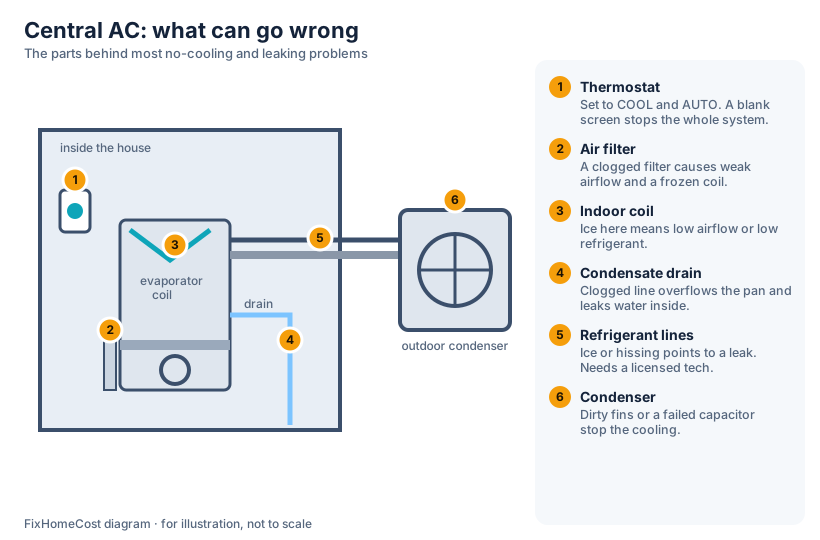
Why the breaker trips in the first place
A breaker isn't broken just because it trips. It's a heat-sensitive switch that cuts power when too much current flows for too long, or instantly when there's a short. Your outdoor AC unit is one of the biggest loads in the house, especially for the first second or two when the compressor starts. Anything that makes that startup harder, or makes the system run hot, pushes the current over the line.
So the breaker is usually the messenger, not the problem. The fix is finding out why the AC is pulling so much power.
How to reset an AC breaker safely
- 1
Set the thermostat to "Off." That way the AC won't try to start the moment power comes back.
- 2
At the main panel, find the AC breaker. It's usually a double-pole breaker, two switches tied together, labeled "AC," "condenser" or "heat pump." A tripped breaker sits in the middle or the "Off" position.
- 3
Push it firmly all the way to "Off," then back to "On." Stand to the side of the panel, not directly in front, as a habit.
- 4
Wait at least 5 minutes before turning the thermostat back to cooling. This lets refrigerant pressures settle, so the compressor isn't trying to start against high pressure.
- 5
Turn cooling on and listen to the outdoor unit. If the breaker trips again, whether instantly or after a while, turn the thermostat off and leave the breaker off.
When it trips tells you a lot
- Instantly, the moment you reset it, even with the thermostat off: A dead short in the wiring, the disconnect box, or a grounded compressor. Leave it off. This one is electrical and needs a pro.
- A second or two after the AC tries to start: A hard start. Usually a weak capacitor, a failing compressor, or a seized fan motor.
- After running 10 to 30 minutes: Overheating. A dirty outdoor coil, a clogged filter, a failing fan motor, or a hot afternoon on a system that's already struggling.
- Only on the hottest days: The system is near its limit. Think dirty coils, low refrigerant, or a breaker that's getting weak with age.
- After a storm: A power surge may have damaged the capacitor or the control board.
8 common causes
1. Dirty air filter
Starved airflow makes the system run longer and harder, and can freeze the coil. It's the cheapest thing to rule out.
2. Dirty outdoor coil
Cottonwood fluff, grass clippings and dust block the fins. The unit can't shed heat, so pressure and current climb until the breaker trips.
3. Failing capacitor
The capacitor gives the compressor and fan motor their starting kick. When it weakens, the motors draw much more current to start. It's one of the most common AC repairs.
4. Failing fan motor
If the outdoor fan is slow or stuck, the unit overheats within minutes. Worn bearings also pull extra current.
5. Hard-starting compressor
An aging compressor may need more help to start. A hard-start kit sometimes buys years. A compressor that's shorted or grounded has to be replaced.
6. Loose or corroded wiring
Loose connections at the contactor, disconnect or breaker heat up and cause trips. Rodents chewing wires can cause shorts.
7. Low refrigerant
A leak makes the compressor run longer and hotter, often alongside weak cooling or ice on the lines.
8. A worn-out or wrong-size breaker
Breakers weaken after years of hot starts. A breaker smaller than the unit's nameplate allows will also trip.
What you can safely check yourself
- 1
Replace the air filter. Check the size printed on the old one.
- 2
Turn the AC off at the thermostat and at the outdoor disconnect box, usually a gray box on the wall near the unit. Then look at the outdoor coil. If the fins are matted with fluff or dirt, gently rinse them from the inside out, or from top to bottom, with a garden hose. No pressure washer.
- 3
Clear plants, leaves and debris for about 2 feet around the unit, and make sure nothing is blocking the fan on top.
- 4
Look, but don't touch, at the top of the unit and the disconnect box. Melted insulation, scorch marks, a burnt smell, or a capacitor with a bulging top all point to the culprit. Take a photo for the technician.
- 5
Check the unit's nameplate for "Max fuse/breaker size," and compare it to the number on the breaker handle. Write both down. A technician or electrician will want them.
Tools and materials
- New air filter
- Garden hose with a spray nozzle
- Flashlight and phone camera
Approximate DIY cost: $5 to $40
Call a pro when
- It trips instantly, even with the thermostat off
- It trips again after one reset
- You see scorch marks, melted wires or a swollen capacitor
- The outdoor unit hums or buzzes but the fan won't spin
- The breaker or panel is hot to the touch
Cost to fix an AC breaker that keeps tripping
| Job | Typical cost |
|---|---|
| AC service call or diagnostic | $75–$200 |
| Outdoor coil cleaning | $100–$400 |
| Run or start capacitor, installed | $120–$400 |
| Hard-start kit, installed | $150–$400 |
| Contactor replacement | $150–$400 |
| Replace the AC breaker | $100–$400 |
| Replace the outdoor disconnect box | $120–$450 |
| Condenser fan motor replacement | $300–$700 |
| Compressor replacement | $800–$2,500+ |
Ranges are typical US prices compiled by FixHomeCost from published cost guides. Compressors are often under a 10-year parts warranty, so you may pay only labor. If a compressor fails on a system over 12 to 15 years old, compare the repair against a new system in our AC replacement cost estimator.
Common questions
Why does my AC breaker keep tripping?
The AC is drawing more current than the circuit allows. The usual culprits are a dirty filter or outdoor coil, a weak capacitor, a failing fan motor or compressor, or loose wiring. Less often, the breaker itself is worn out.
Is it safe to keep resetting my AC breaker?
No. Reset it once. If it trips again, leave it off. Repeated resets strain the compressor and can turn a small repair into a very expensive one. Never reset it if you smell burning or see scorch marks.
Can a dirty filter make the AC breaker trip?
Yes. A clogged filter restricts airflow, so the system runs longer and harder and can freeze the coil, which raises current draw. It's the first and cheapest thing to check.
Can a bad capacitor trip a breaker?
Yes. A weak capacitor makes the compressor and fan motor draw much more current to start. That often trips the breaker within a second or two of startup. Replacing one typically costs $120 to $400.
How do I know if the breaker or the AC is the problem?
A technician measures the current the AC draws and compares it to the nameplate. If the draw is normal and the breaker still trips, the breaker is likely worn. If the draw is high, the problem is in the AC.
Why does my AC breaker trip only on hot days?
Heat raises refrigerant pressure and current draw. A system with a dirty coil, low refrigerant, a weak capacitor or an aging breaker may cope on mild days and trip on the hottest ones.
Related guides
This is general information, not a professional inspection. Electrical work can be dangerous; hire a licensed professional. See how we research costs.